
Chapter 5
Kafue
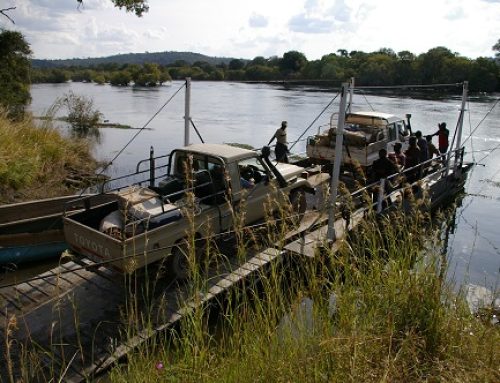
The Lubungu pontoon crosses a gracefully wide stretch of the Kafue River, where its broadness slows and smooths the flow of the water. Here the sideways tug of the current is reduced when the old rusted raft plies its way back and forth. Like a worn-out biblical beast of burden serving a mindless destiny, it is held on course by the stretch of two lines to the guide-cable
The early morning found Gideon watching wisps of vapor spread like a threadbare carpet over the river’s surface. At this time of day, when the ferry crew are still rousing in their huts across the river, it often takes a lot of shouting and banging on the steel anchor pillars to get a response. Luckily, the owner of a sad little sedan was already doing some boisterous rousing. With itsd dents and scratches Gideon couldn’t make out the vehicles brand, or if its dull gray color emanated from its original hue or from its thick coat of dust. Bald tires and a crack running the length of the windshield added to its air of fateful resignation. It fitted seemlessly into the scene.
Some of its passengers, children, stood at the water’s edge skipping stones. Two women sat above them on the bank formed by the cut of the road as it dropped down to the load point. Gideon had a sense of unease as he watched the kids. He knew how shockingly quickly, and how far, a crocodile can reach when it erupts from the river’s sluggish margins. This section of the river held some of the biggest crocs he had ever seen, agents of the underworld.
While exchanging a few pleasantries, the owner of the dilapidated sedan mentioned he was heading with his wives and their five children to the town of Chipata on the other side of the country.
“A long way to go!” Gideon replied with a hint of sympathy for such a journey cramped in that small a car. The man shrugged. He didn’t expect or need sympathy. Few people from outside Africa can fully understand how expectations of comfort and crowding have different metrics. Why would anyone who slept on a woven straw mat spread on the dirt floor of a hut all their life be bothered by the cram of a car.
As they waited, an equally dilapidated truck pulled up behind them. Most of its occupants were women wearing billowing black skirts, and red jackets with wide lapels matching their white head scarves: Jehovah’s Witnesses, Gideon surmised. Or maybe not, otherwise there should have been some blue somewhere. He couldn’t remember. In any case, their garb reflected the colorful promise of their religion.
As they invariably do, the children from the truck joined the others skipping stones over the water. The image of the age-wrinkled face of the camo-clad man flickered into Gideon’s mind, contrasting with the colorful garb of the women. He wondered if Jesus had learn such a skip step trick on the waters of the Jordan, or Mary Magdalen wore bright colors when she washed his feet.
The women would find it more difficult to blend into the Bush than had the old man with his drab clothing. There was something vaguely prophetic about that, Gideon thought. He wondered if the mission-molded ideas in the women’s heads were as colorful as their clothes. Would they be as durable as the black magic under the camo man’s gray curls? In two hundred years, whose ideas would still be skipping across the waters of this river: the old traditional, or the recently imported?
Ahhh, but it was all bullshit. Gideon envied their ability to believe in anything when life’s currents surged sideways. Too bad he no longer had much belief to darken the hue of his sun-burned soul.
Finally, he noticed the crew slowly walking across from their huts to where the pontoon was beached on the far bank. Then. when they pivoted and gunned the engines, swirling the water to grind the heavy draw bridge into the gravel of the bank on this side, he cautiously followed the dusty little sedan over the crunch of the stones and the metallic clank of the drawbridge up onto the pontoon’s platform.
The old Bedford truck with its colorful burden of belief would have to wait for the next crossing.
It was time to move. Ernest would be waiting!